Columnaris
aka: False Neon Disease, Saddleback Disease, Cotton Wool Disease, Mouth Rot, Mouth Fungus.
Originally we thought that Columnaris was caused by just one bacterium Flavobacterium columnaris, but more recently these have been isolated into 4 distinct types, F. columnare, F. covae, F. davisii, and F. oreochromis (Harrison et. al 2025). There is also evidence for a 5th species (Zamparo et al 2025). All of these are referred to as columnaris causing bacteria (CCB).
Symptoms
Fin and Body rot
Fins rot, often with a red line at the edge of the infected fin. Large craters might be visible on the body.
Skin Lesions.
Grey, white or yellow patches on the body. One symptom that is identifiable is the saddleback pattern. A white patch located behind the dorsal fin.
Mouth rot
The mouth starts to rot, the jaw bones are likely to be infected and also rot.
Anal rot
The anus will start to rot, this is often followed by bloat/dropsy as water invades the internal cavities.
Gill damage
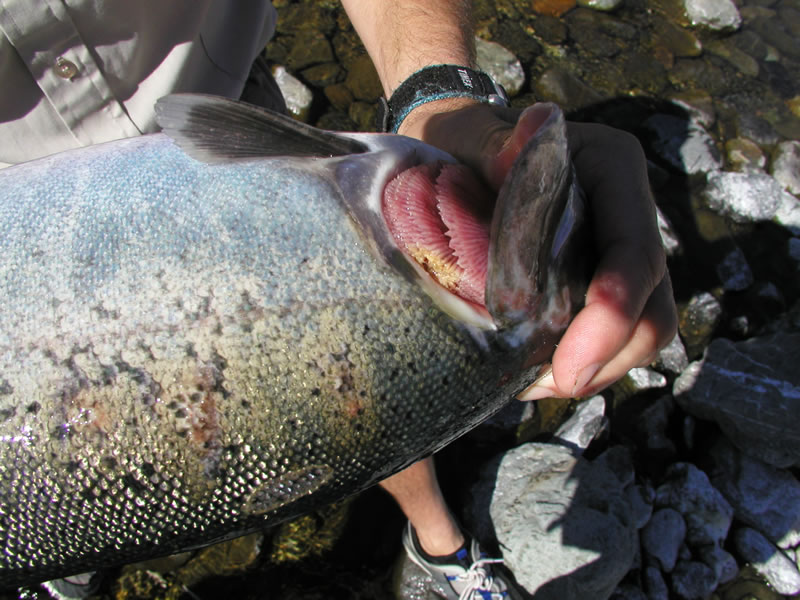
Not something that is visible for the most, but if the fish have pale, or deformed gills you might notice the gills are patchy, and a brown colour. Be aware that brown gills is also a symptom of nitrite toxicity.
Cotton wool disease
Often on the mouth the fish appears to be eating a piece of cotton wool. It’s not clear if this is the Columnaris itself, or more likely a secondary infection by Saprolegnia.
Sudden death
Studies have shown that are 20 ºC young salmon died in less than 12 hours when exposed to highly virulent strains. This time scale is likely to be lower in tropical tanks.
Flavobacterium columnare can survive in hard water, especially if there is a high organic load, for up to 16 days, but a far shorter period of time in soft water, especially if the organic load is lower. (Declercq et al 2013)
Treatment
Do a large water change immediately to reduce the organic load in the tank, and to reduce the amount of bacteria in the tank. Clean out your filters mechanical media at the same time. Remove and euthanise any severely infected fish before they pass on the disease to healthier fish. Dead fish will pass on the disease to healthy fish at a much higher rate (Declercq et. al 2025)
If you can consider talking to your vet to see if you can get a prescription for an antibiotic. If that’s not possible treat with one of the following. Some of these are affiliate links, which means we get a tiny bit of advertising revenue if you purchase via our links. That helps us carry on writing articles.
NT Labs Anti Ulcer and fin rot
NT labs Anti Internal Bacteria
Waterlife Myxazin (no longer produced, but still available online)
Meth Blue, as a bath.
If you have fish that are salt tolerant, such as mollys, then aquarium salt is a good treatment.
Whilst treating be aware many of these treatments will also impact your filter bacteria, so test regularly, and cut back on feeding.
Prevention is the best option with Columnaris. Keep the amount of waste in your tank low by doing large regular water changes and cleaning your mechanical media regularly. Avoid buying very cheap fish, and always quarantine.
References and further reading.
Bassleer, Gerald: The practical guide to fish diseases: in ornamental tropical, pond fish (and shrimp) eBook :https://amzn.to/48wBkZtAmazon.co.uk: Kindle Store.
Declercq, A.M., Haesebrouck, F., Van den Broeck, W., Bossier, P. and Decostere, A. (2013). Columnaris disease in fish: a review with emphasis on bacterium-host interactions. Veterinary Research, [online] 44(1), p.27. doi:https://doi.org/10.1186/1297-9716-44-27.
Decostere, A., Haesebrouck, F. and Devriese, L.A. (1998). Characterization of four Flavobacterium columnare (Flexibacter columnaris) strains isolated from tropical fish. Veterinary Microbiology, [online] 62(1), pp.35–45. doi:https://doi.org/10.1016/s0378-1135(98)00196-5.
Harrison, C.E., LaFrentz, B.R., Shoemaker, C.A., Lange, M.D., Liles, M.R., Mohammed, H.H., Beck, B.H., Churchman, E.M., Peatman, E. and Bruce, T.J. (2025). An Overview of Vaccine Development Strategies for Columnaris‐Causing Bacteria in Cultured Fish. Journal of Fish Diseases, [online] 48(8), pp.e14155–e14155. doi:https://doi.org/10.1111/jfd.14155.
Ho, D., Putita Chokmangmeepisarn, Kamolwan Khianchaikhan, Morishita, M., Anurak Uchuwittayakul, LaFrentz, B.R. and Channarong Rodkhum (2025). Comparative genomic analysis of Flavobacterium species causing columnaris disease of freshwater fish in Thailand: insights into virulence and resistance mechanisms. BMC Veterinary Research, [online] 21(1), pp.357–357. doi:https://doi.org/10.1186/s12917-025-04488-3.
Google.co.uk. (2019). Google Books. [online] Available at: https://www.google.co.uk/books/edition/Columnaris_Disease_of_Fishes/cqlOIkuA9QwC?hl=en&gbpv=1 [Accessed 11 Dec. 2025].
WAKABAYASHI, H. (1991). Effect of environmental conditions on the infectivity of Flexibacter columnaris to fish. Journal of Fish Diseases, [online] 14(3), pp.279–290. doi:https://doi.org/10.1111/j.1365-2761.1991.tb00825.x.
Zamparo, S., Brocca, G., Marroni, F., Radovic, S., Castellano, C., Torge, D., Bianchi, S., Groman, D., Macchiarelli, G., Muscatello, L.V., Volpatti, D. and Orioles, M. (2025). Metabarcoding Reveals a Potentially Undescribed Columnaris‐Causing Bacterium in Peracute Skin Disease of Rainbow Trout ( Oncorhynchus mykiss , Walbaum). Journal of Fish Diseases, [online] 49(1). doi:https://doi.org/10.1111/jfd.70004.