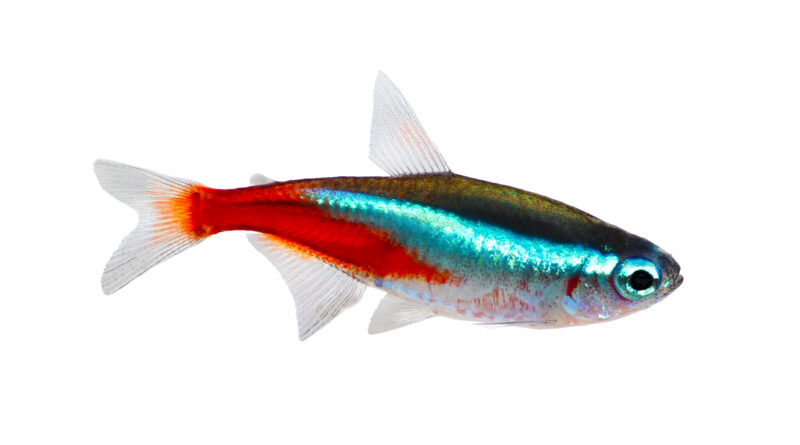
Neon Tetras

Neon Tetras
The little divas of the aquarium world, they not only come with a need for friends, and soft water, but also a disease all of their own.
Discovered nearly 100 years ago, at one point a pair of these cost you the same as a decent house, now they’re the bargain basement tetra mass produced in Asian, but still adapted to live in the dark murky waters of the Rio Negro.
Neons have to be the most misunderstood fish of the hobby, seen as cheap and easy they actually need very low pH, and plenty of tannins to thrive. They also can’t thrive on the left overs of other fish, and as a prey species they struggle to be kept with larger predatory fish. Anglefish being the most common example.
Auguste Rabaut was an interesting gentleman, he was in the Amzon looking for emeralds, and hunting crocodiles for their glands. As well as looking for new species, as gentlemen of the 1930 were want to do. Instead he discovered the Neon Tetra. The travels or Auguste Rabaut is well worth a read. I’ll pop a link in the comment at some point.
He managed to get 13 of these little fish alive to Paris, which is no mean feat, this was a long voyage on a ship, with rudamentary supplies to keep them alive. It’s not recorded how much he sold them for, but they were purchased for $6500, this was in 1935. That was a small fortune then. 5 of those fish were put aboard the Hindeburg the next year, with reports of the cost to ship them ranging up to $3000, only one of these fish made it alive, making that one very expensive tetra. He went on display at the Shedd aquarium, where people flocked to see him.
Now the hunt was on to try and find these new tropical fish. When a new species arrives on the scene there is an initial race to find more of them, and then to breed them, but even once they’d found more Neons, there was a major issue. The Neons would breed, but the eggs wouldn’t hatch, and Neon Tetra disease was wiping out whole colonies.
Two things were needs, the first was water with next to no KH or GH, and the other was partial water changes to keep the microorganism that you don’t want at bay.
Now breeding Neons is so simple that I’m considering breeding my group rather than bothering to go to the shop and get more. But we’ve come a long way in the past 90 years.